New Scientific Project “AntibacHip” Launched in Collaboration Between HKS, FKIT, and Instrumentaria
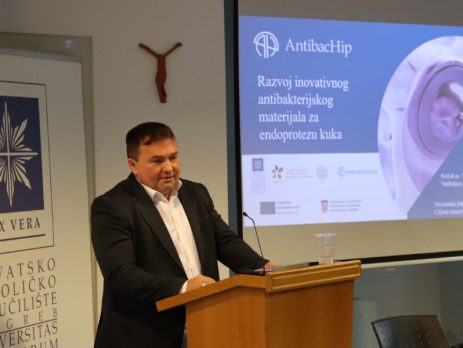
On Friday, December 13, 2024, at the Stepinac Hall of the Catholic University of Croatia, the new scientific project titled “Development of an Innovative Antibacterial Material for Hip Endoprosthesis – AntibacHip” was officially presented. The project is led by the Catholic University of Croatia (HKS), in partnership with the Faculty of Chemical Engineering and Technology (FKIT) at the University of Zagreb, and Instrumentaria d.d.
At the event, partners, researchers, project team members, and collaborators were welcomed by Prof. Željko Tanjić, PhD, Rector of HKS, who expressed pride in the interdisciplinary partnership under HKS’s leadership. He congratulated the team on their innovation and wished them success throughout the two-year project. Additional opening remarks were delivered by Prof. Ante Jukić, PhD, Dean of FKIT, and Mr. Stevica Hodić, Director of Instrumentaria d.d. The AntibacHip project is funded under the “Targeted Scientific Research” call, as part of the National Recovery and Resilience Plan 2021–2026, with a total project value of €1,631,172.52. The grant agreement was signed in August 2024, and the project will run for two years. The project is coordinated by Prof. Tamara Grgurić Holjevac, PhD, representing HKS as the lead partner, in collaboration with FKIT and Instrumentaria d.d. AntibacHip focuses on developing an innovative material for hip endoprostheses with enhanced biofunctionality, antibacterial properties, and the ability to prevent biofilm formation on the implant surface. It addresses the critical issue of post-operative infections following hip replacement surgeries, which can lead to implant rejection, reoperations, and increased healthcare costs. Using advanced technologies, the project aims to create innovative titanium alloys capable of producing cost-effective implants with improved corrosion resistance, superior mechanical properties, and enhanced fatigue strength. These materials will be subjected to laboratory testing through the development of a prototype hip endoprosthesis.